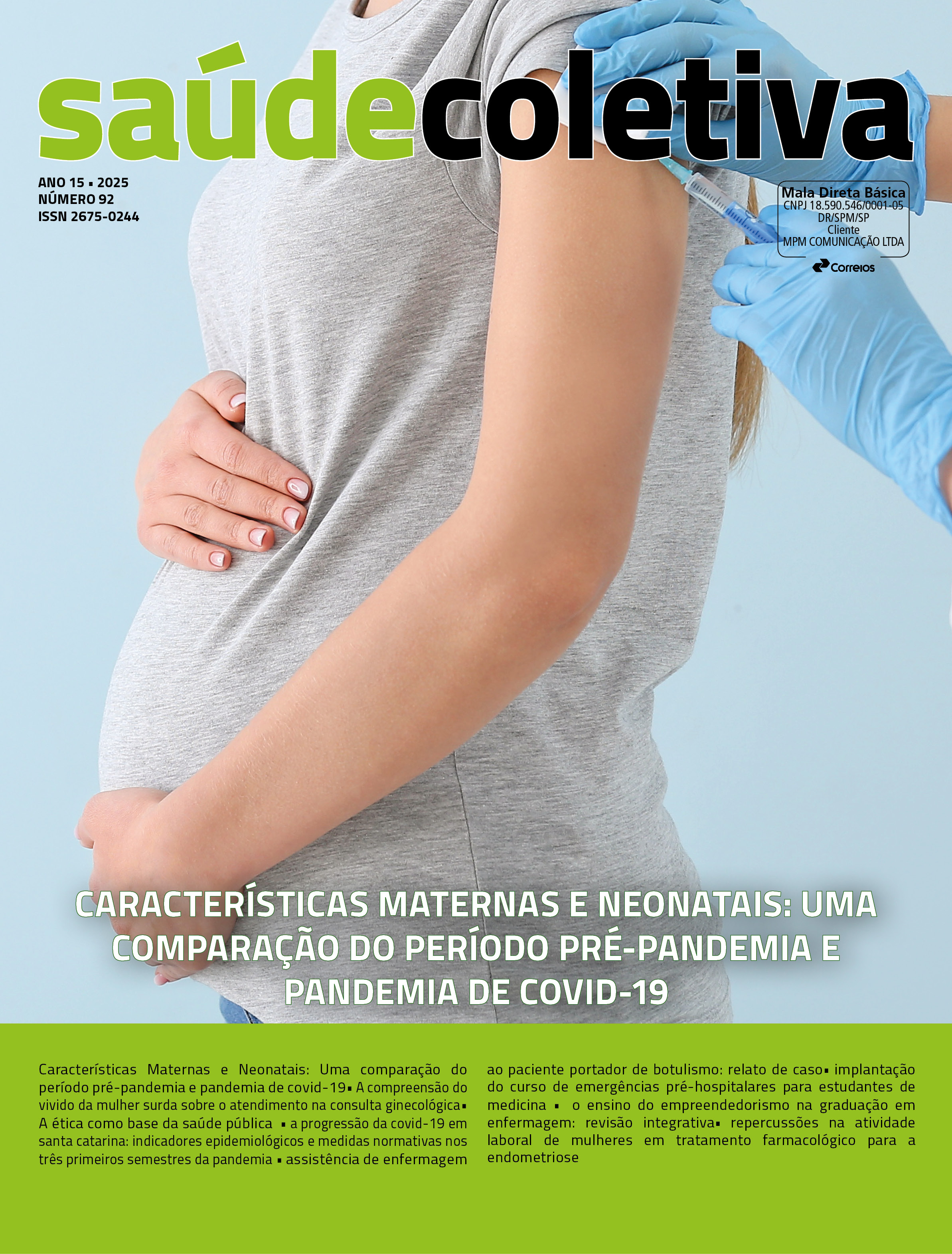
The Progression of COVID-19 in Santa Catarina: Epidemiological Indicators And Normative Measures During the First Three Semesters of the Pandemic
DOI:
https://doi.org/10.36489/saudecoletiva.2024v14i92p13856-13872Keywords:
Coronavirus Infections, COVID-19, Mortality, Decrees, Legislation, Social DistancingAbstract
INTRODUCTION: The aim of this study was to describe the epidemiological indicators and state decrees related to COVID-19 in the first three semesters of the pandemic in Santa Catarina, Brazil. METHOD: An ecological study was carried out that divided the period from January 1, 2020 to June 30, 2021 into three semesters, portraying the epidemiological evolution of COVID-19 and its relationship with state decrees on social distancing. The content of the decrees was grouped into categories for later analysis of their repercussions. RESULTS: During the period, 1,064,044 confirmed cases of COVID-19 were recorded, the largest proportion (50.7%) of which was observed in the first semester of 2021, when there was also a greater number of restrictions (n=43), most of them adopted after an increase in the number of cases. Ten relaxations preceded the first wave of the disease and seven preceded the third. CONCLUSION: It was observed that the measures to relax social distancing were adopted early and abruptly, and that the restrictions were not implemented skillfully to prevent new waves of the disease.
References
Cash-Goldwasser S, Jones SA, Bierrenbach AL, Bochner A, Frieden TR.Weekly COVID-19 Science Review March 3rd – 17th, 2021. Resolve to Save Lives. 2021 Mar. Disponível em: https://preventepi-demics.org/coronavirus/weekly-science-review/
Brasil, Ministério da Saúde. Painel de casos de doença pelo coronavírus 2019 (COVID-19) no Brasil. Acesso 29 jun. 2021. Disponível em: https://covid.saude.gov.br/
Brasil, Ministério da Saúde. Doença pelo coronavírus covid-19: Semana epidemiológica 67. Bol Epidemiol. 17 jun. 2021. Disponível em: https://www.gov.br/saude/pt-br/centrais-de-conteudo/publicacoes/boletins/boletins-epidemiologicos/covid19/2021/boletim_epidemiologico_covid_67.pdf
Russo Rafael R de M, Neto M, de Carvalho MMB, Leal David HMS, Acioli S, de Araujo Faria MG. Epidemiology, public policies and covid-19 pandemics in Brazil: What can we expect? Rev Enferm. 2020;28:1–6. Disponível em: http://dx.doi.org/10.12957/reuerj.2020.49570 DOI: https://doi.org/10.12957/reuerj.2020.49570
Falcão P, Souza AB de. Pandemia de desinformação: as fake news no contexto da Covid-19 no Brasil. Rev Eletrônica Comun Informação e Inovação em Saúde. 2021 Mar 22;15(1). Disponível em: https://doi.org/10.29397/reciis.v15i1.221 DOI: https://doi.org/10.29397/reciis.v15i1.2219
Lamontagne F, Agoritsas T, Siemieniuk R, Rochwerg B, Bartoszko J, Askie L, et al. A living WHO guideline on drugs to prevent covid-19. Vol. 372, The BMJ. BMJ Publishing Group; 2021. Disponível em: https://doi.org/10.1136/bmj.n526 DOI: https://doi.org/10.1136/bmj.n526
Cotta RM, Naveira-Cotta CP, Magal P. Mathematical Parameters of the COVID-19 Epidemic in Brazil and Evaluation of the Impact of Different Public Health Measures. Biology (Basel) [Internet]. 2020 Ago 12 [citado 2021 Abr 23];9(8):220. Disponível em: https://www.mdpi.com/2079-7737/9/8/220 DOI: https://doi.org/10.3390/biology9080220
M Lauro. Boletim COVID-19 em SC: Ainda não é hora de flexibilizar as medidas de controle da pandemia. Florianópolis: Universidade Federal de Santa Catarina. Núcleo de Estudos de Economia Catarinense. 2021. Boletim no 51. Disponível em: https://drive.google.com/file/d/1ZgrFB2QJ0U-vdh6tgapdJJukydAXZANrM/view
Garcia LP, Traebert J, Boing AC, Santos GFZ, Pedebôs LA, d'Orsi E, et al. O potencial de propagação da covid-19 e a tomada de decisão governamental: uma análise retrospectiva em Florianópolis, Brasil. Rev Bras Epidemiol. 2020; 23: e200091. doi: http://doi.org/10.1590/1980-549720200091. DOI: https://doi.org/10.1590/1980-549720200091
Hughes HMFBR, Carneiro RAVD, Hillesheim D, Hallal ALC. Evolução da COVID-19 em Santa Catarina: decretos estaduais e indicadores epidemiológicos até agosto de 2020. Epidemiologia e Serviços de Saúde. 2021;30(4):2021-. Disponível em: https://doi.org/10.1590/S1679-49742021000400025 DOI: https://doi.org/10.1590/s1679-49742021000400025
Gerência de Transparência e Dados Abertos. Portal de dados abertos do estado de Santa Catarina. Acesso 30 nov. 2021. Disponível em: http://dados.sc.gov.br. Acesso em 30 nov. 2021.
Ibrahim RL, Ajide KB, Olatunde Julius O. Easing of lockdown measures in Nigeria: Implications for the healthcare system. Health Policy and Technology. 2020;9(4):399-404. Disponível em: https://pubmed.ncbi.nlm.nih.gov/32959012/ DOI: https://doi.org/10.1016/j.hlpt.2020.09.004
Mégarbane B, Bourasset F, Scherrmann JM. Is Lockdown Effective in Limiting SARS-CoV-2 Epidemic Progression?—a Cross-Country Comparative Evaluation Using Epidemiokinetic Tools. Journal of General Internal Medicine. 2021;36(3):746-52. Disponível em: https://www.ncbi.nlm.nih.gov/pmc/articles/PMC7806254/ DOI: https://doi.org/10.1007/s11606-020-06345-5
McGrail DJ, Dai J, McAndrews KM, Kalluri R. Enacting national social distancing policies corresponds with dramatic reduction in COVID19 infection rates. 2020;15:e0236619-e. Disponível em: https://journals.plos.org/plosone/articleid=10.1371/journal.pone.0236619 DOI: https://doi.org/10.1371/journal.pone.0236619
Lai S, Ruktanonchai NW, Zhou L, Prosper O, Luo W, Floyd JR, et al. Effect of non-pharmaceutical interventions to contain COVID-19 in China. Nature. 2020;585(7825):410-3. Disponível em: https://doi.org/10.1038/s41586-020-2293-x DOI: https://doi.org/10.1038/s41586-020-2293-x
Hadjidemetriou GM, Sasidharan M, Kouyialis G, Parlikad AK. The impact of government measures and human mobility trend on COVID-19 related deaths in the UK. Transportation Research Interdisciplinary Perspectives. 2020;6:100167-. Disponível em: https://www.sciencedirect.com/science/article/pii/S2590198220300786 DOI: https://doi.org/10.1016/j.trip.2020.100167
Heo G, Apio C, Han K, Goo T, Chung HW, Kim T, et al. Statistical estimation of effects of implemented government policies on covid-19 situation in south korea. International Journal of Environmental Research and Public Health. 2021;18(4):1-12. Disponível em: https://www.mdpi.com/1660-4601/18/4/2144/htm DOI: https://doi.org/10.3390/ijerph18042144
Ferguson NM, Laydon D, Nedjati-Gilani G, Imai N, Ainslie K, Baguelin M, et al. of non-pharmaceutical interventions (NPIs) to reduce COVID-19 mortality and healthcare demand. Disponível em: https://www.imperial.ac.uk/media/imperialcollege/medicine/sph/ide/gida-fellowships/Imperial-College-COVID19-NPI-modelling-16-03-2020.pdf
Da Silva LLS, Lima AFR, Polli DA, Razia PFS, Pavão LFA, De Hollanda Cavalcanti MAF, et al. Social distancing measures in the fight against covid-19 in brazil: Description and epidemiological analysis by state. Cadernos de Saude Publica. 2020;36(9). Disponível em: https://www.scielo.br/j/csp/a/gR6mkQmSqBHqvZb5YMNYjxD/?lang=en DOI: https://doi.org/10.1590/0102-311x00185020
Hale T, Webster S, Petherick A, Phillips T, Kira B. Oxford COVID-19 Government Response Tracker, Blavatnik School of Government; 2020. https://www.bsg.ox.ac.uk/research/research-projects/coronavirus-government-response-tracker
Fortaleza CMCB, Guimarães RB, De Almeida GB, Pronunciate M, Ferreira CP. Taking the inner route: Spatial and demographic factors affecting vulnerability to COVID-19 among 604 cities from inner São Paulo State, Brazil. Scopus. 2020. Disponível em: https://www.ncbi.nlm.nih.gov/pmc/articles/PMC7324662/ DOI: https://doi.org/10.20944/preprints202004.0497.v1
De Andrade LOM, Filho AP, Solar O, Rígoli F, De Salazar LM, Serrate PCF, et al. Social determinants of health, universal health coverage, and sustainable development: case studies from Latin American countries. Lancet (London, England). 2015;385(9975):1343-51. Disponível em: https://pubmed.ncbi.nlm.nih.gov/25458716/ DOI: https://doi.org/10.1016/S0140-6736(14)61494-X
Petherick A, Kira B, Barberia L, Furst R, de Janeiro Rafael Goldszmidt R, de Janeiro Maria Luciano R, et al. Brazil's fight against COVID-19: risk, policies, and behaviours. 2020. Disponível em: https://github.com/OxCGRT/Brazil-
de Moraes RF. Determinants of physical distancing during the covid-19 epidemic in Brazil: Effects from mandatory rules, numbers of
cases and duration of rules. Ciencia e Saude Coletiva. 2020;25(9):3393-400. Disponível em: https://www.scielo.br/j/csc/a/FCZCydTmk3GG7Hn-hGX83yyn/?lang=en DOI: https://doi.org/10.1590/1413-81232020259.21892020